

The Egypt e-Visa is the better choice for most travelers – it costs the same as a visa on arrival ($25 single-entry) but lets you skip the airport queue, guarantees approval before you fly, and eliminates the risk of being turned away at the border. Visa on arrival works fine for spontaneous trips, but the e-Visa removes uncertainty entirely.
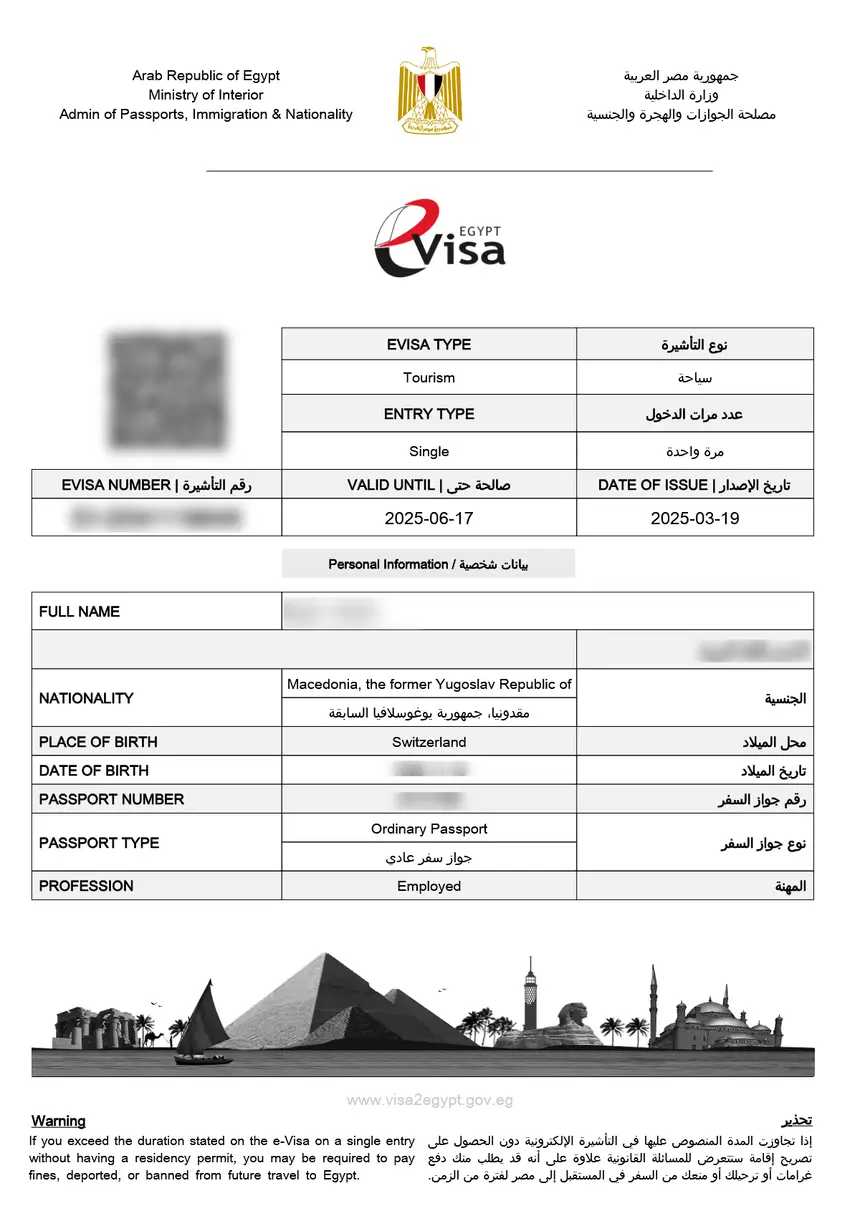
Both options grant a 30-day stay in Egypt. The key difference is when and how you get your visa. This guide breaks down every factor – cost, processing time, eligibility, convenience, and risk – so you can pick the right method for your trip.
e-Visa vs Visa on Arrival: Quick Comparison
| Factor | e-Visa | Visa on Arrival |
|---|---|---|
| **Cost** | $25 (single) / $60 (multiple) | $25 (single-entry only) |
| **Processing time** | 5-7 business days | Instant at airport |
| **Application** | Online before travel | In-person at airport bank counter |
| **Payment** | Credit/debit card online | Cash (USD preferred) or card |
| **Stay duration** | 30 days per entry | 30 days |
| **Validity** | 90 days from issue | Valid on arrival only |
| **Multiple entry** | Available ($60) | Not available |
| **Risk of denial** | Before travel (low risk) | At the airport (higher stakes) |
| **Eligible countries** | 46+ nationalities | 46+ nationalities (same list) |
| **Best for** | Planned trips, families, business | Last-minute travel |
What Is the Egypt e-Visa?
The Egypt e-Visa is an electronic travel authorization issued through the official government portal at visa2egypt.gov.eg. You apply online, upload your passport scan, pay by card, and receive the approved visa as a PDF by email.
Key features:
– Single-entry ($25): One entry within 90 days of issue, 30-day stay
– Multiple-entry ($60): Unlimited entries within 90 days, 30 days per entry
– Processing: Typically 5-7 business days (can be faster)
– Format: Digital PDF – print it or show on your phone at immigration
The e-Visa system launched in 2017 and has processed millions of applications. It is the officially recommended method by the Egyptian government for tourism and short business visits.
What Is the Egypt Visa on Arrival?
The visa on arrival is a sticker visa you purchase at Egyptian airports after landing. You buy it from bank kiosks in the arrivals hall before reaching passport control.
How it works:
1. Land at an Egyptian airport (Cairo, Hurghada, Sharm El Sheikh, Luxor, etc.)
2. Find the bank kiosk in the arrivals area
3. Pay $25 USD cash (or by card at some counters)
4. Receive a visa sticker
5. Place it in your passport
6. Proceed to passport control
The process typically takes 10-30 minutes depending on queue length. During peak tourist season (October-April), wait times can stretch longer.
Cost Comparison
Both options cost the same for a single entry: $25 USD. However, there are hidden cost differences:
| Cost Factor | e-Visa | Visa on Arrival |
|---|---|---|
| Visa fee | $25 | $25 |
| Currency exchange markup | None (pay online) | Possible (if paying in local currency) |
| Multiple entry option | $60 | Not available |
| Time cost | None (approved before travel) | 10-30 min airport queue |
| Re-application risk | Low (approved in advance) | Moderate (denied at border) |
Bottom line: If you only need a single entry, the monetary cost is identical. The e-Visa saves you time at the airport and removes the uncertainty of border-side approval.
Eligibility: Who Can Use Each Option?
Both the e-Visa and visa on arrival are available to citizens of 46+ countries, including:
- United States, Canada, United Kingdom, Australia
- All EU/Schengen member states
- Japan, South Korea, China
- Russia, Ukraine
- Brazil, Argentina, Mexico
- India, Pakistan (with conditions)
Important: Citizens of countries not on the eligible list must apply for a traditional embassy visa in advance. There is no visa-on-arrival option for ineligible nationalities. Check the official e-Visa portal for the current eligibility list.
Processing Time
| Method | Timeline | When You Know |
|---|---|---|
| e-Visa | 5-7 business days | Before your trip |
| Visa on Arrival | Instant | After landing |
The e-Visa requires planning – apply at least 7 days before departure to be safe. Some applications are approved in 48 hours, but busy periods can push it to 10+ days.
Visa on arrival is immediate, which makes it appealing for last-minute trips. But “immediate” assumes no complications at the counter.
Convenience and Airport Experience
e-Visa advantages at the airport:
– Skip the bank kiosk queue entirely
– Walk directly to passport control
– No need to carry exact cash
– Print or show PDF on phone
– Less stress, especially with children or tight connections
Visa on arrival advantages:
– No advance paperwork
– No online account creation
– No waiting for email approval
– Works for spontaneous travel decisions
Families traveling with children benefit most from the e-Visa – standing in a bank kiosk queue with tired kids after a long flight is nobody’s idea of a vacation start.
Risk Factors
This is where the two options diverge significantly.
e-Visa risks (low):
– Application rejected (rare – usually due to passport validity or incorrect info)
– Processing delay (apply early to avoid this)
– Technical issues with the portal (uncommon)
Visa on arrival risks (moderate):
– Bank counter closed (rare but reported at smaller airports)
– Card payment machine down (carry USD cash as backup)
– Passport validity issue caught at the border (no time to fix)
– Peak season queues of 45+ minutes
– Airline may deny boarding if you lack proof of visa eligibility
The biggest risk with visa on arrival is discovering a problem when it’s too late to fix it. With the e-Visa, any issues surface days before your flight.
When to Choose the e-Visa
The e-Visa is the better option when:
– You’re traveling on a planned itinerary with booked flights and hotels
– You want multiple entries (e.g., side trip to Jordan or Israel)
– You’re traveling with family or a group
– You have a tight connection between flights
– You want peace of mind before departure
– Your passport is from a country with stricter scrutiny
When to Choose Visa on Arrival
Visa on arrival makes sense when:
– You’re making a spontaneous trip with less than 7 days notice
– You forgot to apply for an e-Visa before departure
– You’re arriving on a charter flight to a resort airport (Hurghada, Sharm El Sheikh)
– You prefer not to share personal data online through the e-Visa portal
Can You Get Both?
Technically, yes – but there’s no reason to. If you have a valid e-Visa, you don’t need a visa on arrival. If you plan to get a visa on arrival, don’t waste time on an e-Visa application.
Exception: If your e-Visa application is still pending and your flight is tomorrow, you can proceed with a visa on arrival instead. The two systems don’t conflict.
Special Cases
Cruise Ship Passengers
Passengers arriving by cruise ship at ports like Alexandria or Port Said typically receive visas through the cruise line. Neither e-Visa nor visa on arrival applies – check with your cruise operator.
Sharm El Sheikh Only
Travelers staying only in the Sharm El Sheikh resort area for up to 15 days may qualify for a free entry permit (Sinai-only permit). This does not cover travel to Cairo, Luxor, or other cities.
Dual Nationals
If you hold Egyptian citizenship alongside another nationality, different rules apply. Egyptian law may require you to enter on your Egyptian passport.
Step-by-Step: How to Apply for the e-Visa
- Visit visa2egypt.gov.eg
- Create an account with your email
- Fill in personal details (name, passport number, nationality)
- Upload a passport scan (bio page)
- Select visa type (single or multiple entry)
- Pay $25 or $60 by credit/debit card
- Wait 5-7 business days for email confirmation
- Download and print the e-Visa PDF
For a detailed walkthrough, see our Egypt e-Visa application guide.
Common Mistakes to Avoid
- Applying too late: Submit your e-Visa at least 7-10 days before departure
- Wrong passport validity: Your passport must be valid for 6+ months beyond arrival
- No blank pages: Immigration needs at least 1-2 empty pages
- Assuming all airports accept VOA: Only international airports have bank kiosks
- Forgetting to print the e-Visa: While phone display usually works, a printed copy is safer
- Using a third-party site: The official portal is visa2egypt.gov.eg – other sites charge extra fees
FAQs About Egypt e-Visa vs Visa on Arrival
Is the Egypt e-Visa cheaper than visa on arrival?
No. Both cost $25 for a single entry. The e-Visa offers a $60 multiple-entry option that isn’t available for visa on arrival.
Can I switch from visa on arrival to e-Visa after landing?
No. Once you’ve received a visa on arrival, that’s your visa. You cannot apply for an e-Visa for the same trip.
What if my e-Visa application is denied?
You can reapply with corrected information or opt for a visa on arrival at the airport. Common denial reasons include passport validity issues or mismatched personal details.
Do children need their own e-Visa or visa on arrival?
Yes. Every traveler, regardless of age, needs their own visa. Children can be included in a parent’s e-Visa application process but receive separate approvals.
Can I use the e-Visa at any Egyptian airport?
Yes. The e-Visa is accepted at all Egyptian international airports including Cairo (CAI), Hurghada (HRG), Sharm El Sheikh (SSH), Luxor (LXR), and Alexandria (HBE).
Is visa on arrival available 24/7?
Bank kiosks at major airports like Cairo operate around the clock. Smaller airports may have limited hours. Carry USD cash as a backup in case card machines are down.
Which option is better for US citizens?
The e-Visa is recommended for US citizens. It costs the same, eliminates queues, and provides proof of visa approval before boarding. See our complete guide for US citizens for more details.
How far in advance should I apply for the e-Visa?
Apply at least 7 days before departure. The e-Visa is valid for 90 days from the date of issue, so you can apply up to 3 months early without any downside.
Can I extend an e-Visa or visa on arrival in Egypt?
Both can be extended at a Mogamma (government building) in Cairo. The extension process adds 30 days and costs additional fees. Neither option auto-extends.
What happens if I overstay my 30-day visa?
Overstaying results in fines at the airport when departing. The penalty varies but is typically a per-day fee. Overstaying can also affect future visa applications.